Showing posts with label rome. Show all posts

Friday, March 13

Building A British Hot Sauce

Boring. That could sum up the last two weeks in England. The wife has been out and about all over the world and I have been holding down the fort. The weather here has finally started to come around and its already time to start mowing the lawn.

Left to my own devices, I was craving spicy food. No sense trying to go out and find spicy food here, I had to make my own.

Here is my recipe for British-inspired hot sauce/marinade:

  • About 100 chile de arbol peppers, stems removed.
  • 3 Scotch Bonnet peppers (or more, I should have had more!)
  • 4 cloves garlic
  • Lots of Marmite. Seriously, lots. A whole jar might be about right.
  • 1/4 c. dry Coleman English mustard
  • 1/2 c. raisins
  • 1/2 c. vinegar
  • Mix and match chile pepper from the Turkish bazaar.
  • Allspice, whole, maybe a tablespoon.
  • A good splash of good, smoky grappa from Rome. Trust me, this was perfect.
Steep chile de arbol peppers in hot water for about an hour. Remove stems from Scotch bonnets. Mix Coleman's with cold water to make a paste and let it sit for about 15 minutes. Put the allspice in a dry pan and toast over medium-low heat until fragrant, then crush in a mortar and pestle. Throw everything in a good blender and blend for a while. Season to taste with salt and Marmite. Pack in old bottle. Slather on Pig-in-a-Box pork shoulder chunks, broil until brown and your eyes burn. Serve with dairy products and more grappa!

The end results were excellent and the hot sauce has proved to be good on most everything with meat in it. Good just as salsa for chips, too.

Cheers!


Friday, July 18

Defintion of Dumbass Tourist

Whilst on our tour of Rome, we were en route between the Pantheon and the Vatican and decided to stop off at Sant'Agostino, a church in Rome that houses a work by Raphael and another by bad-boy artist Caravaggio (this guy liked to drink a lot and carry a sword.) We had walked up the steps and were three steps in the doorway when we realized everyone was crying and wearing black. We had also somehow overlooked the hearse sitting at the bottom of the steps, loaded with casket. We left hastily and without checking out the artwork.

On my day off, I decided to try again and this time, I was able to take my time inside. This church and another, Santa Maria at the Plaza del Popolo, are two small churches that get a relatively small amount of tourists but are amazing inside. A big difference between these places and the larger houses of art and relics is that they don't mind you taking pictures; at one place they even offered a suggestion as to where to stand to take the best picture.

Sant'Agostino displays Madonna di Loreto by Caravaggio, a depiction of an apparition of the virgin with child to two pilgrims. It was shocking at the time it was painted because the Virgin Mary looks like a common person in common surroundings, not an exalted figure. Also in Sant'Agostino is The Prophet Isiah by Raphael. In the center view of Sant'Agostino, you can see this fresco on the second pillar on the left.

Santa Maria houses two more Caravaggio's, The Crucifixion of St. Peter and The Conversion On The Way To Damascus. Both these and Annibale Carracci's Assumption of the Virgin Mary are packed into the same small chapel -- hard to take a good picture here.


This wasn't the first Carracci we'd seen. The day before, we had a tour of the French Embassy in Rome. I'd read about this place in Rough Guide's 25 Ultimate Experiences Italy. You have to make an appointment and provide all of your passport details in advance. The tour itself was free (but in Italian -- just nod and smile, nod and smile) and lasted about an hour.

The embassy is housed in the Palazzo Farnese, a palace built by a family with close ties to the Church. This place was impressive and belies it relatively plain exterior. Michelangelo was one of the artists who brought the place to its current form, but it underwent several transformations. The highlight of the tour was the Carracci Gallery, a room with art influenced by the Sistine Chapel. The ceiling and walls are all done in frescoes depicting the gods of Roman mythology. Both the missus and I agreed, on some levels, the effect of this room was more intense then the Sistine Chapel. No pictures allowed here, though, and online images of this place are hard to find. I found one nice shot and included it.

Thursday, July 17

The Keys to Heaven

"And I will give unto thee the keys of the kingdom of heaven: and whatsoever thou shalt bind on earth shall be bound in heaven: and whatsoever thou shalt loose on earth shall be loosed in heaven." - Mathew 16:19

While in Rome, I went to Vatican City twice. The first time was with my wife and we first did a self-tour of St. Peter's Basilica and then a very special tour of the Vatican Museums and the Sistine Chapel. I went again on my one lone day in Rome and my hope was to climb up to the dome of St. Peter's. Once I got there, I realized how lucky we had been on our first trip when it only took 20 minutes to get inside St. Peter's. This time, the line was at least 2 hours long! I gave up my plan for the dome and instead just sent some post cards from the Vatican Post Office.

I don't know much about the Roman Catholic church, but in our tour of the Vatican, our guide repeatedly showed us symbology of the keys in St. Peter's hand. The Roman Catholic church believes that Jesus gave Peter the keys to heaven and through this authority he became the first Bishop of Rome and hence was the very first pope. The authority of all popes is inherited from this. The Basilica is built over Peter's tomb (and also a pagan cemetary from way back.)

The slideshow here is from all over St. Peter's and the Vatican Museums. The magnitude of the place is hard to fathom or describe for someone else. You can see why the Vatican needed to loot many of the other Roman landmarks for the building materials and art that you see here. Recycling at its best.

Wednesday, July 16

If It Bleeds, We Can Make Sausage Out Of It

A friend of mine in high school, Mike Bell, used to work at a butcher in town. He often joked about how you can put anything in to sausage and no one would know. Later in life, I did some charcuterie of my own and while doing some research, learned how true this was. When making hot dogs, for example, some manufacturers use bits of bone and whatnot treated with chemicals to make them soft enough to grind right into the mix. Mmm.

When I walk into a store like the one in the pictures here -- and there are places with similarities to this in the States -- I think about how far some things have fallen from where they started. Look at this meat! I am so tempted, now that I can get it home, to get me one of them cured pig legs turned prosciutto crudo on its special little (ok, not that little) pig leg holder (see pic below) so I can just carve off a bit whenever I am inclined (which would be often).

This is where we bought most of the meat in my previous post. It is a shop right on the Campo de' Fiori.

But, sorry Italy, the best ham I ever had was when we did our tour of Spain. The first stop was Madrid and the first place we stopped in was a little bar that had plates of sliced ham. We payed an outrageous amount for a plate of paper thin slices of ham but, oh man, was it tasty. This was the legendary jamón ibérico de bellota, similar to prosciutto but in their final days the pigs can only eat acorns, imparting a complex nutty taste on the final ham.

I'm drooling.


Tuesday, July 15

The Spoils of Rome

I do a pretty good job of complaining about how much crap we buy on holiday (that's vacation for you Yankees). I don't like bothering with hauling the crap on to the plane, worrying about if the bottle of tasty-whatever-it-is packed in my underwear has broken, etc. Of course, I don't complain when we get home and I have some seriously tasty business to deal with.

The picture is crap but let me tell you what we got (this is just the food!)

Back row, from left to right: dried tomatoes, moscato (dessert wine), moscato, empty box for balsamic vinegar, olive oil, bucatini (tube pasta). Next row: fat jar of spicy salami spread (I think), jar with 'wick' is spicy pepper paste, other jar is some other spicy spread, grappa berta, black truffle paste, whole black truffles, balsamic vinegar, bag o' pasta seasoning with garlic and peppers. Front Row: cured meat, spicy cured meat, dried meat, some other meat.

We haven't touched a thing yet... there might be some left for travelers that make it our way.

Saturday, July 12

Burnin' For You


"Perhaps you, my judges, pronounce this sentence against me with greater fear than I receive it."

These were the final words of Giordano Bruno, a man I knew nothing about. His haunting statue is the focal point of a plaza, the Campo de' Fiori, that was just outside our hotel.

Now, after a bit of reading, I know his statue marks the spot where he was stripped naked and burned at the stake, just after having his jaw locked into an iron gag and having a spike driven through his tongue.

Bruno was convicted of numerous crimes by the Roman Inquisition. He had some very controversial views for his era, including the whole 'the earth isn't the center of the universe' idea. He also held beliefs that had contradictions with the Christian idea of the Trinity. Further, he apparently had developed a system of mnemomics that provided him with an incredible memory. This brought him both some fame and some problems. The fame side landed him a job teaching a duke of Venice his memory tricks. The problems came when some of his critics attributed his abilities to magic. Eventually, his gig with the Duke went sour and the Duke turned him in to the Man aka the Inquisition. It was downhill from there. The final straw was when Pope Clemente VIII showed he was in favor of a guilty verdict. On February 17, 1600, he was executed.

400 hundred years later, a statement was issued during the papacy of John Paul II, basically saying they were sorry and that mistakes had been made regarding his execution. Not every one agrees, but Bruno is now considered to be a significant contributor to modern chains of thought in both science and philosophy. The statue above was erected in 1889 and gazes in the direction of the Vatican. His story has been used in several literary works, fiction and not. He also has a crater on the moon named after him.

There, now we all know a little bit more about my creepy statue pic. Cheers!

Thursday, July 10

But Mama, What About The Food?

I had no idea what to expect from food in Rome. Italian food in the States is probably my least favorite to eat out (this includes you, Mr. Olive Garden). Fortunately, I've read that the majority of Italian restaurants outside of Italy don't get the dishes right so most of us only have a rough idea of what Italian food is all about.

A typical Italian meal (more likely at lunch, the big meal of the day) might include a first course (primo) of pasta or antipasta (or both), a main course (secondo) of meat or fish, then dessert or fresh fruit, then some strong coffee. Of course, all with wine.

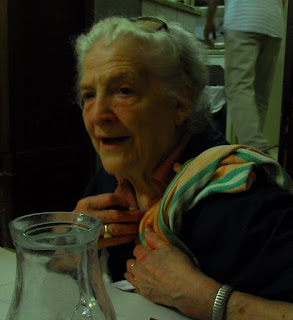
First night we wandered to a place that sounded fantastic: no menu, an old Italian lady cooking in the back, and nobody speaks a word of English. The food was very simple and not all that bad -- it just gave us the feeling that Ada, the lady in back, had decided to cash in on our tourist dollar (the place apparently had just been mentioned in several new tourist books.) The wine was nearly swill even by my standards. The highlight of the night turned out to be the worldly couple sitting next to us: they were from Israel but had lived in London for many years and were now back in Israel. We traded contract details since one of our future trips might be to their country. That said, there was a second old lady at the place who sat and talked to us for quite some time even though we had no idea what she was saying. She was the good kind of crazy and I loved it. She even let me take her picture but she couldn't really stop talking long enough to pose!
Saturday, we had just left Vatican City and were looking for a bite to eat on the way to the hotel. We were no doubt in a touristy area but ended up with a good meal. This is where I had Roman-style tripe (2) (stomach with a tomato and pecorino cheese sauce) and it was very tasty. Not like the tripe they put in Mexican menudo which too often smells like the wrong end of the stomach! The missus had a spaghetti with red sauce and small chunks of sea bass in it (3). Both dishes were simple but delicious.
Sunday night was a hunt for a place our limo driver from the airport had recommended. It was easily worth it but the walk was more than we bargained for. Trattoria Da Bucatino was in Testaccio, a funky neighborhood (a bit rough looking) built up around an old Roman landfill. We had two of the specialties: Bucatini all'amatriciana (2) and fettucini with a truffle and cheese sauce (2). The bucatini was a pasta like spaghetti but a bit thicker and with a hole in it (a tube!). The dish had chunks of bacon, a rich and spicy tomato sauce, and lots of pecorino. A typical meal out for us means we keep trading dishes and I was having trouble deciding which one was better. The food was excellent.

Monday night was a place right next to our hotel. The Hostaria Costanza served up the most refined food of our trip. To start, I had a risotto with squash flowers (1) and R had another simple dish, pasta a cacio e pepe, that was a spaghetti-like pasta with more pecorino and sharp black pepper (2). That risotta was the single best thing I ate on the trip. We followed that course up with veal saltimbocca and a mixed sea food fry (including whole anchovies and a whole baby cod). Good, but a small step down from the pasta course. We drank the house white wine all night. To finish, we went for dessert at this place: a chocolate gelato and zabaglione. Followed that up with some grappa, a strong brandy traditionally made from the grape wastes after winemaking. A meal that I wouldn't mind repeating.
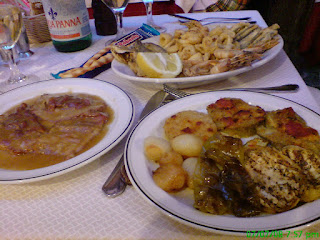
Tuesday night was a place right next to our hotel (another one). The Trattoria Der Pallaro was bustling and we didn't get there until well after 10PM. It was a set menu (nothing written down, no one spoke English) that just kept coming. It started with plates of cured prosciutto crudo, black olives, fantastic little green lentils, fried risotto balls (arancini), fried savory dumplings, and super-fresh tomatos with basil and olive oil. Next round was big rigatoni with pecorino cheese (anyone else notice a theme?) and chunks of bacon -- this was a rich dish. The main course was a thick slice of roasted veal with a side of homemade potato crisps, broad beans with mint, and some chunks of buffalo mozzerala. A tart came for dessert -- it had a crust that had cornmeal in it, I think, with an apricot-ish jam on top. It reminded me of popcorn. This place had a great vibe and the meal was solid from start to finish.

If I learned anything in Rome, its that I have barely scratched the surface of good Italian food. I definitely want to go back and check out some of the other regions and see what they have to offer. I don't think I can cook this stuff at home, though. I think I would cringe when I realized how much cheese, olive oil, and bacon went into some of these dishes -- best I never know.

Cheers!

Pan Pizza

A while back, my dear wife had shown me some article about some photo software that stuck in my head. It basically allows you to take a bunch of digital pictures of the same scene and "stitch" them together into one giant picture. In Rome, I recalled this and took several series of 'panoramic' pictures: I basically stood in one spot and slowly rotated as I took pictures. Once home, after some digging, I found many of these stitching programs available, often with free limited or trial versions, that will do just what I wanted. My favorite so far is AutoPano Pro (trial version): it has a slick interface, supports a 64-bit system, and has no issues figuring out what photos go where. For a complete list, check out my favorite freeware site: Gizmo's Tech Support.

These pictures end up being so big, I haven't found a good way to fit them in the blog. The best bet is to click on them as they play below; this will transfer you right to my Google Web Album for better viewing.

In this batch:

  • The Colosseum, where gladiators fought to the death against man and animal alike. They had fighting fests here where 1000's of animals were slaughtered. Pictures of both the inside and the outside are shown. This thing would have collapsed if one of the popes hadn't invested in the engineering of new support walls around 1807 to maintain it.
  • Piazza del Popolo: A newer public square in Rome, its current version is only a couple of hundred years old. The obelisk in the middle of the square is from Egypt and is around 2000 years old.
  • The Roman Forum: This was the town center of ancient Rome. It was a religous, political, and commercial center. Like a giant mall with temples and courthouses.
Cheers!


Man On The Run

One day of our Roman holiday, we found ourselves in search of a wireless hotspot so that email and such could get sync'd up. After all, there is work to be done.

It ended up we found a free WiFi zone at the Pantheon McDonald's. The Pantheon is a major landmark and is considered by many to be the best example of Roman architecture still standing. It also shares its square with a McDonald's. It was built as a temple to the many gods of the Romans (pantheon literally means something like 'temple of all gods') around 125AD. As is often the case in Rome, this temple was built on top of another temple that was even older. Sometime after 600AD, the Christians got their hands on it and made it into a church. The amazing feature of the thing is the domed roof that stands even in modern day as the largest unsupported concrete dome in the world -- it weighs in at 5000 tons. Those crazy Romans did all this without cranes, calculators, or the Internet.

One of the biggest blights on Rome was the ever-present street vendors selling fake designer handbags and sunglasses. It is actually illegal to buy a bag from these guys. I had time to kill whilst my better half was working so I was walking around snapping some pictures. Most of the action centered around the fountain in the middle of the square. Then entered the first attack wave of the carabiniere (Rome's quasi-military police force -- many of these guys carry machine guns.) The street vendors grabbed their goods and took off running. The police chased them away and out of sight.

Moments later, many of the same vendors cautiously returned to the square. Some new vendors arrived to fill in the freed space for the ones who didn't make it back. Minutes later, another wave of carabiniere rode through on motorcycles and again the cycle repeated. This happened over and over in the 20-30 minutes that I was standing there, zoom lens in hand.

To protect the not-so-innocent, I have fuzzed a lot of the images so that faces aren't as clear but you should still get the idea.

Wednesday, July 9

Judge Not

It's too late to blog much today but we are back in England and, not surprisingly, its raining buckets.

I was flipping through the 1700 photos I took over the last few days and thought if I had to pick just one for a quick post, this one is as good as any. This is Michelangelo's "The Last Judgment" from the rear wall of the Sistine Chapel. It was painted over an eight year period from 1534 to 1541. It depicts the second coming of Christ and then some. When it was completed, it was quite the controversy since there was so many naked bits on display. Michelangelo worked the likeness of one of his chief critics into the the bottom right hand corner or Hell. He also put his own self-portrait (just up and to the right of dead center) on a suit of flayed skin, representing St. Bartholomew, a saint who had been skinned alive. This was apparently a display of the resentment Michelangelo held towards doing this work.

Cheers!